Understanding the operation before building the infrastructure for growth.
Imagine a family-owned business that's been operating successfully for 30 years. The owners know their customers, their employees know their jobs, and over time, they've figured out what works.
Then they decide to open a second location.
Suddenly, questions arise that they've never really needed to answer. How will they train new employees? What systems will connect the two locations? Who makes decisions when the owner isn't there? Much of what makes the business successful may exist in the knowledge and experience of a few individuals. We've all encountered some version of this: "Sorry, Larry's on vacation. He'll be back next week." It's a simple interaction, but it reveals operational bottlenecks and gaps.
Learn Before You Build
Whether you're starting a business, expanding an existing operation, or stepping into an established organization, the approach is similar. You need to understand how the business works and what is required to operate successfully.
If you've spent years in an industry, you likely have a good understanding of how things should function. That experience is valuable, but it can also create assumptions. It's easy to approach an operation with a picture of how things should work simply because that's how you've always seen them done.
The goal isn't to replicate what already exists. It's to understand it well enough to recognize where it can be improved. Why is a process structured this way? Does it still serve its purpose? Is there technology that could make it more efficient?
If you're entering an unfamiliar industry, you may need to learn from experienced operators or the people doing the work. Either way, remain curious about what the operation could become.
A simple SWOT analysis can be a useful starting point. Identifying strengths, weaknesses, opportunities, and threats helps establish an initial perspective. Often, the most useful insights come from observing daily operations, talking with employees, and questioning established practices.
Map the Operation
Once you begin to understand the business, start putting the pieces together.
Think about the full cycle, from the first customer or patient interaction through service delivery, billing, and follow-up. Walk through each step. What happens? Who is responsible? What systems are involved? Where are decisions made? And importantly, is there a better way?
Mapping isn't simply documenting how things are done today. It's an opportunity to evaluate whether the processes, systems, and staffing models are still the best way to operate.
Some workflows may be efficient and worth keeping. Others may involve unnecessary handoffs, outdated technology, or unclear responsibilities. Often, the gaps only become visible when you begin connecting one part of the operation to another.
The example below illustrates how an operator might map a patient life cycle, capturing the processes involved, questions that arise, and opportunities worth exploring.
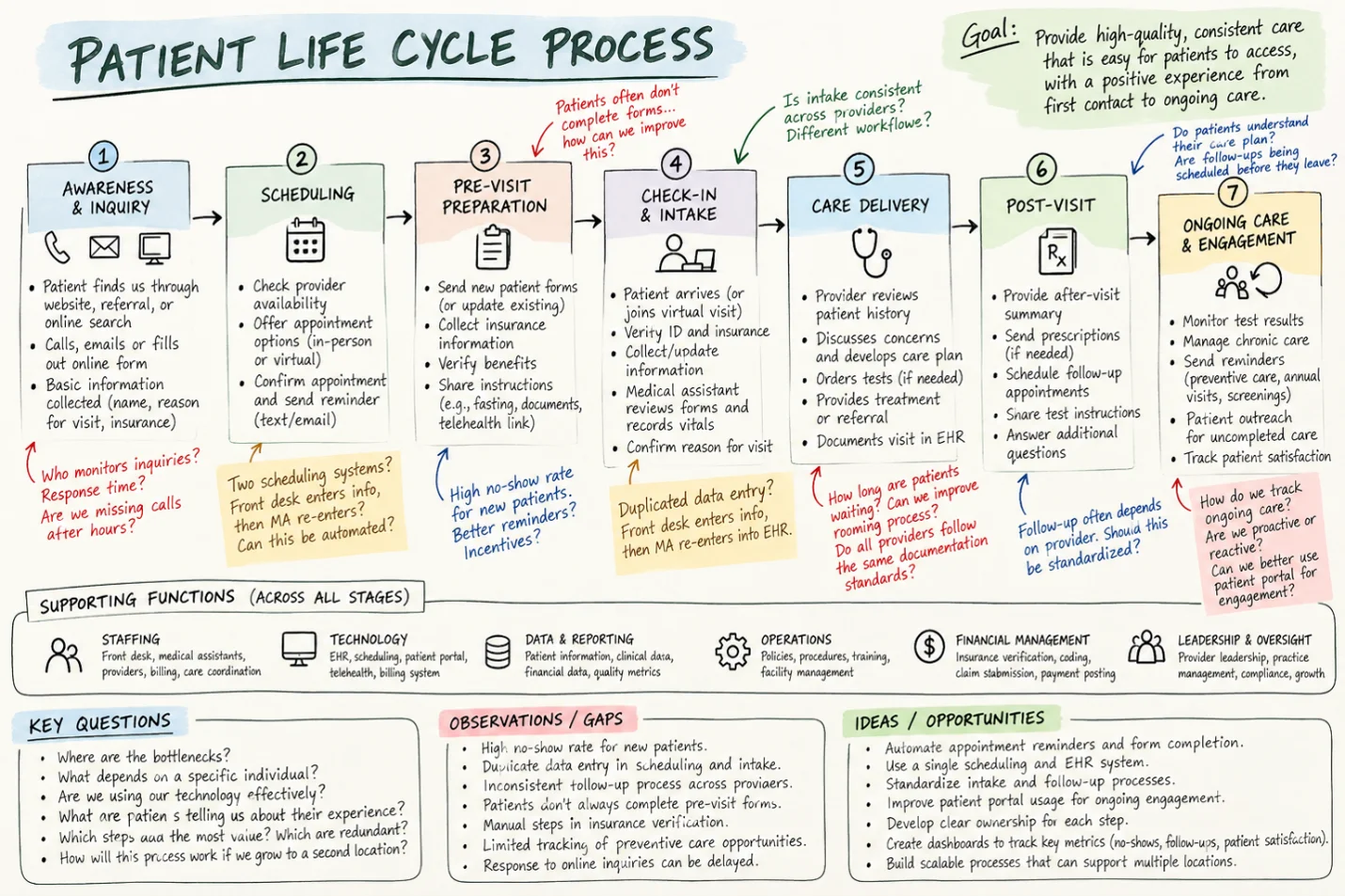
Notice that this isn't a finished operating plan. It's a working document. The handwritten questions, observations, and potential improvements are just as important as the process itself.
I like to start with a whiteboard or a piece of paper. The goal is to get the operation out of people's heads and into a format that can be reviewed, challenged, and shared with the team.
As you map, consider the people, technology, finances, and leadership responsibilities supporting each step. Think about what works today, what could work better, and what will be needed as the business grows. You don't need every answer immediately. The process will probably raise more questions than you anticipated, and that's part of its value.
What's Next?
Mapping helps you see the work ahead, but it doesn't necessarily tell you where to begin.
In our next Journal article, we'll take that map and start building from it, exploring how to prioritize opportunities, understand dependencies, and determine what needs to happen first.